 Skip to content
 Supplying Australian businesses since 2010
5.0 on Google from 150+ reviews
Inkjet vs laser printer: which suits your office?
An inkjet costs less to buy and a laser usually costs less per page, so the answer comes down to how much your office prints.
A plain guide for Australian offices, with its sources listed below.
Which is better for an office, inkjet or laser?
A laser usually suits an office that prints most days, while an inkjet usually suits one that prints a little and wants photo quality colour.
An inkjet sprays liquid ink onto the page through tiny nozzles.
A laser uses a dry powder called toner, which is fused to the page with heat.
That one difference drives the cost to buy, the cost per page and how each machine copes with sitting idle.
Why the amount you print decides it
Inkjet and laser side by side
These points come from HP and Brother, two companies that make both kinds of printer, checked on 11 October 2026.
How an inkjet prints
Liquid ink is sprayed onto the page through tiny nozzles.
How a laser prints
Toner powder is laid on the page and fused with heat.
| What you are comparing | Inkjet | Laser |
|---|---|---|
| How it prints | Liquid ink sprayed through tiny nozzles | Toner powder fused to the page with heat |
| Cost to buy | Usually lower | Usually higher |
| Cost per page | Usually higher | Usually lower |
| Speed on long runs | Generally slower | Generally faster |
| Strongest at | Photos and rich colour images | Sharp text and everyday documents |
| If left unused | Ink can dry out | Toner does not dry out |
Brother notes that newer inkjets have closed much of the speed gap on everyday jobs.
Sources: HP on laser printers and inkjets and Brother Australia on choosing inkjet or laser.
Five questions that settle it
Answer these for your own office, or run them through our printer quiz, and the choice usually makes itself.
-
VolumePages a month
How much do you print?
A few pages a week rarely justifies the higher price of a laser.
Printing most days is where the lower cost per page of a laser starts to count.
-
ContentText or photos
What do you print?
Contracts, invoices and reports are where a laser is strongest.
Photographs are generally better from an inkjet.
-
Idle timeGaps between jobs
Does it sit unused?
Ink can dry out when a printer goes a long time between jobs.
Toner is a dry powder, so a laser copes better with long gaps.
-
SharingPeople per machine
How many people use it?
One person at one desk can work with either type.
A team sharing one machine usually needs the speed and capacity of a laser.
-
FeaturesBeyond printing
Do you need A3, scanning or stapling?
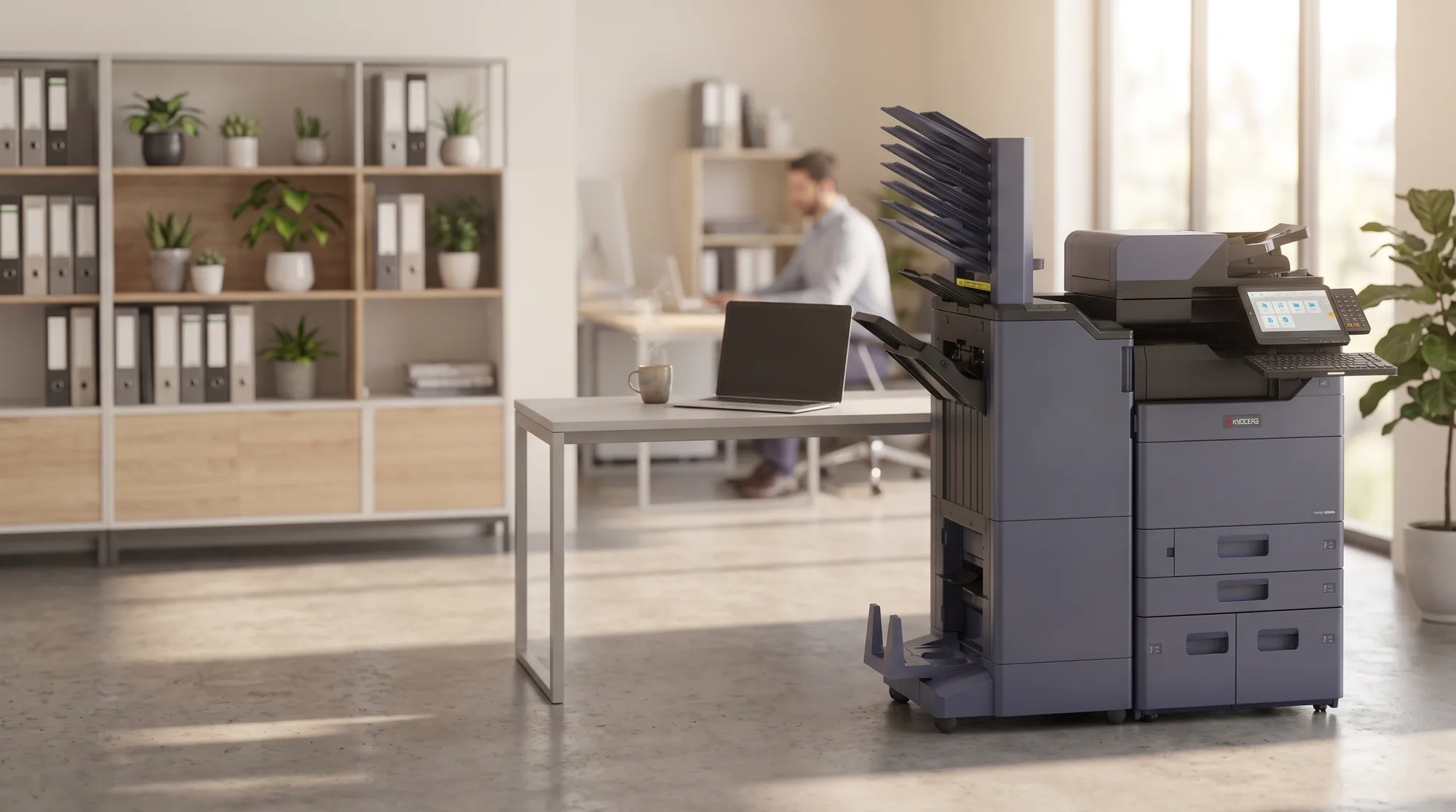
Larger paper, fast scanning and finished documents are the work of an office multifunction machine.
That is a different class of machine from a desktop printer of either type.
Which one fits your office?
Neither type is right for every office.
An inkjet usually fits when
- You print a few pages a week
- Photos or colour images matter more than text
- One person uses the printer
- The purchase price matters most
A laser usually fits when
- You print most days
- Most of what you print is text
- Several people share the machine
- The cost per page matters more than the purchase price
- The printer may sit unused for weeks
A very small office that prints little is often better off buying a small printer than leasing anything.
When the laser is a lease, not a purchase
Once a laser is the right machine, the next question is whether to buy it or lease it.
A lease puts the machine, toner, parts, technician labour and servicing into one monthly figure, within the page allowance on your quote.
Buying keeps the machine yours, with toner and repairs left for you to arrange and pay for.
The lease or buy guide sets the two side by side.
If a desktop machine is all you need, see what an A4 laser printer lease includes.
Three steps from here
A rough page count is all you need to turn this into real numbers.
Not sure how much you print?
Many printers can show a page count in their settings menu, and two readings a month apart give you the figure.
-
Count roughly how many pages your office prints in a month.
-
Decide whether you need colour, A3 or scanning as well as printing.
-
Ask us for one written figure, and compare it with the price of buying a machine.
5.0 on Google, from 150+ reviews
Two Google reviews from offices we look after, shown word for word.
Cyrus and his Team amazing.
Printer installed next day.
Training provided by great team.
Highly recommend Global Document Solutions as they worked to tailor a perfect solution for our business.
We replaced our existing machine (also through GDS) and, as always, the process was seamless. We had our machine up and running with minimal downtime. Thanks Cyrus and team.
Questions about inkjet and laser printers
Is a laser printer cheaper to run than an inkjet?
Usually yes, because toner generally costs less per page than ink.
A laser usually costs more to buy, so the saving shows up over time.
Is an inkjet or a laser better for a small office?
A laser is usually the better fit when a small office prints most days.
An inkjet can be enough for an office that prints only a few pages a week.
Does toner dry out like ink?
No, because toner is a dry powder.
Ink can dry out when a printer is not used regularly.
Can a laser printer print in colour?
Yes, colour laser printers handle colour documents well.
They usually cost more to buy than black and white lasers.
Which is better for photos?
An inkjet is generally the better choice for photographs.
A laser is stronger at sharp text and clean lines.
Can I lease a laser printer instead of buying one?
Yes, we lease laser printers and multifunction machines on terms of 36, 48 or 60 months.
Toner, parts and servicing are included, within the page allowance on your quote.
Find out what a laser would cost your office
Send a rough monthly page count and one written figure comes back.
If a small printer you buy yourself is the better answer, we will tell you.
This guide is general information, and costs and features vary from model to model.
Our services come with guarantees that cannot be excluded under the Australian Consumer Law.